


Your existing access


Your agents keep their own sign-ins. Bring a Moonshot or Z.ai key for Skyflo's own agent on any plan; it stays in your Keychain.
Model keys and supported agentsThe agentic operating system for your company
Give Skyflo a goal. It coordinates your AI agents to get work done, under limits you set.
Start free. No card. macOS 14+.Agent subscriptions and model keys you bring are billed by their providers.Plans and pricing
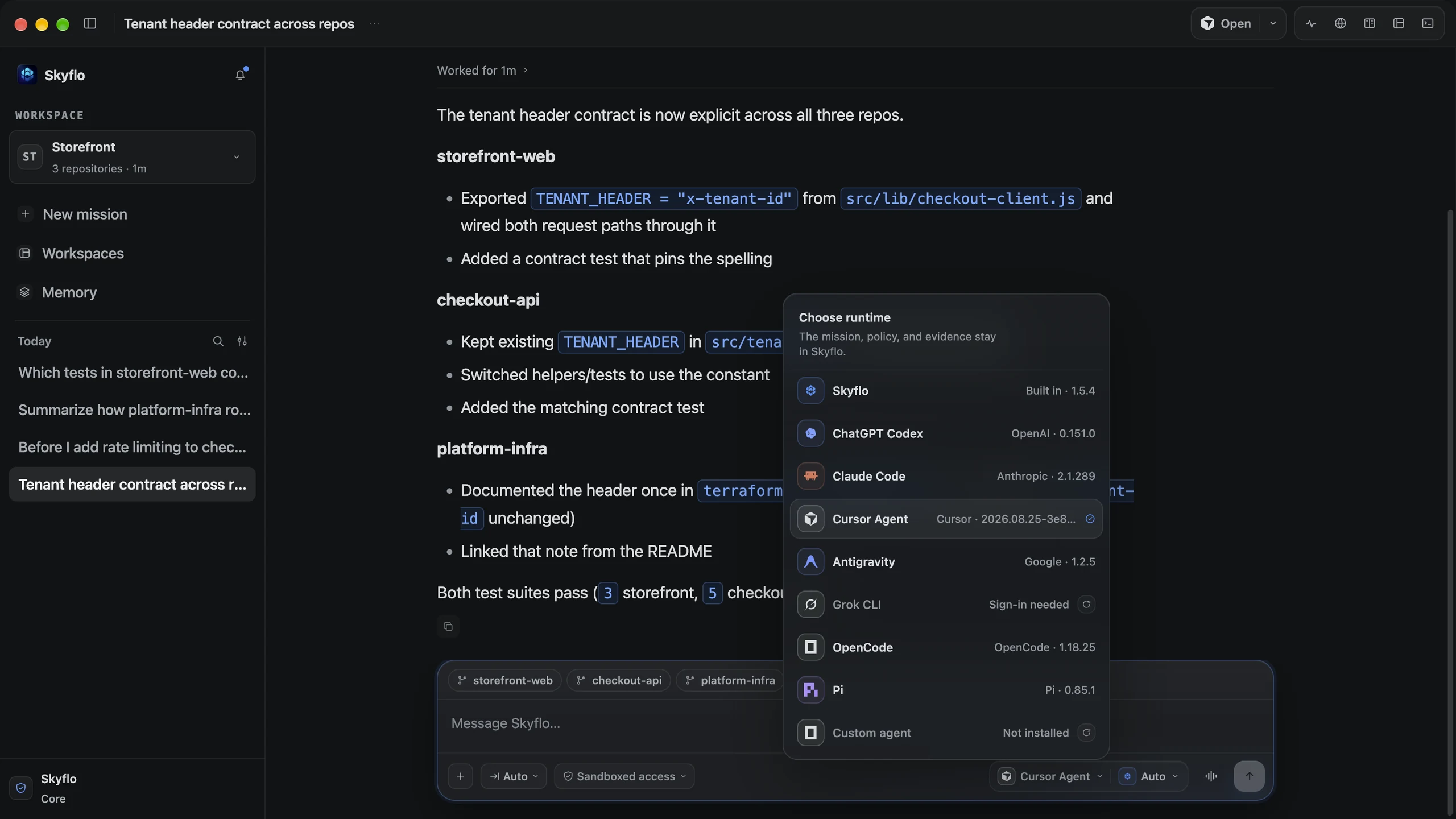
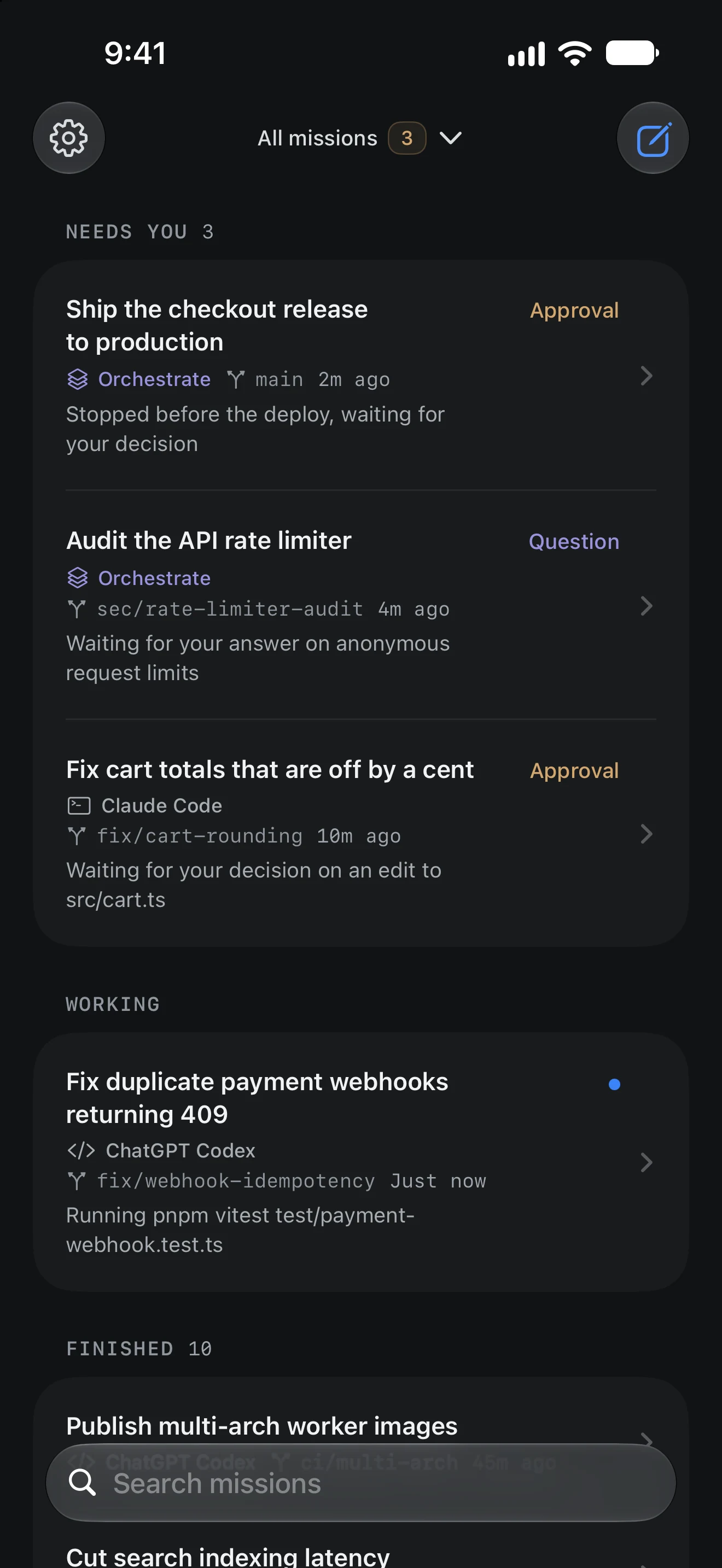
Skyflo for Mac. The iPhone app is a Preview, in App Store review.
One recorded example, on Skyflo for Mac 1.5.4.
Give your agents a clear outcome, the context they need and the limits to follow. Start with one real objective.
Carry a feature through the API, its clients and the contract between them, with the agents you already use.
What you get
A change in each repository, the shared contract and the checks that ran.
Skyflo reads your account notes and past calls, checks public sources and briefs you before the meeting.
What you get
A prospect brief that keeps facts, guesses and open questions apart.
Give it the product brief and the date. It plans back from launch day and drafts the material.
What you get
A launch plan with owners, deadlines and approval gates.
More agents should mean less coordination. Skyflo keeps the goal, context and permissions together as work moves between them.

Skyflo control plane
Holds the mission, whichever agent runs it

Skyflo's own agent
Bring any other ACP agent through a manifest file.
Your agents keep their own sign-ins. Bring a Moonshot or Z.ai key for Skyflo's own agent on any plan; it stays in your Keychain.
Model keys and supported agentsCore, Pro and Max include models, Voice Mode and Skyflo Cloud. No key to bring.
Compare models and capacityUsing them directly or through Skyflo:Claude CodeCodexCursor
Start a mission in Skyflo Cloud, or move one from your Mac. It keeps working while your Mac sleeps.
Included with Core, Pro and Max.
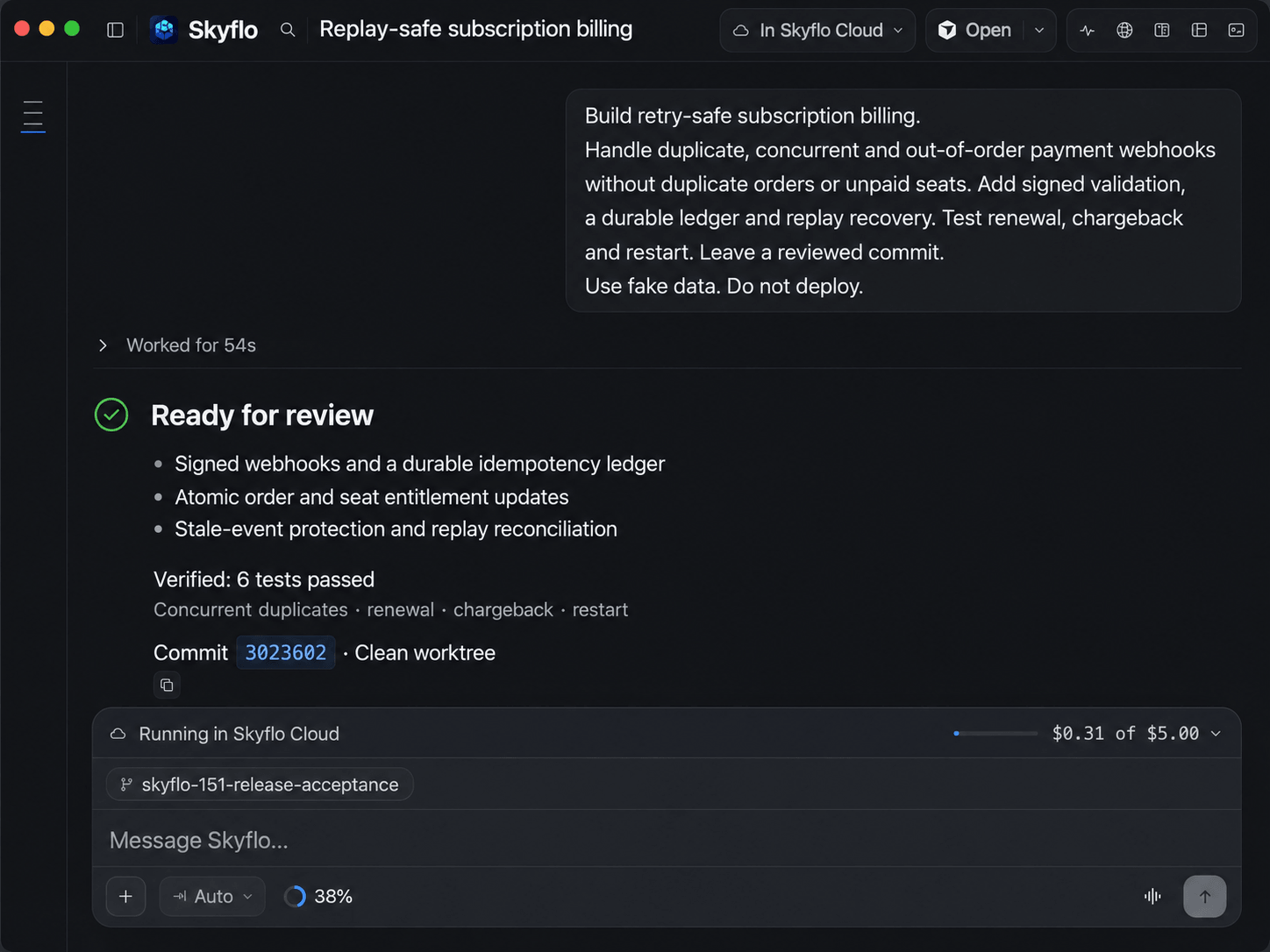
Delegate the whole task or work through it together. It all stays in one mission.
Skyflo's own agent works in a browser and terminal you can see. Step in, then hand it back.
Take over, hand backTalk through a goal, check progress or redirect a mission while it runs.
Core, Pro and Max
See Voice ModeRun work daily, on chosen weekdays or once.
What Skyflo's own agent can useSkyflo joins your calls from a mission. Ask out loud, and the work starts before the call ends.
Skyflo AIHi everyone, I'm here for the Q4 launch brief. I don't record audio or video.
billing/churn-2026-09.csvscripts/churn_by_plan.pyNeeds approval from the calllaunch-brief.mdSkyflo keeps what finished work proved and brings it back when the next mission needs it.
Skyflo improves how it improves. It gets better at routing work, and your approvals, credentials and spending limits stay out of its reach.
Conventions you state and commands that worked become memory, linked to their source. Proven sequences become Skills.
Task layer · memory and Skills
Skyflo learns which agent and model fit each task. A change stays only while it keeps winning.
Meta layer · routing, judged on held-out routes
Approvals, credentials, spending limits and kill switches are out of its reach. Only a signed release changes them.
Root layer · changed only by a signed release
Pick an access mode per mission. Every agent follows it, and every decision is recorded.
Access mode
Applies to every agent in the mission
Every command and edit stops and waits for you.
New Auto missions start in Full access and Orchestrate starts in Ask for approval. Change it in the composer before you send.
Work mode
Each specialist writes in its own Git worktree, so parallel edits never collide with yours.
A separate reviewer checks the work and reports findings. It cannot edit a file.
Every permission decision, tool call and finding goes into one append-only record on your Mac.
Use it for your own work today. Bring it to your team when it proves itself.
Install Skyflo, connect an agent you already use and give it a real task.
Free, no card.
Evaluate Skyflo on your own work, from research and analysis to a launch or software delivery.
Turn company goals into coordinated agent work. Research, product, operations and engineering share the same need: a clear objective, the right context and control over what happens next.
Agents run on your linked Mac unless you start or move a mission to Skyflo Cloud. BYOK credentials stay in the macOS Keychain.
Skyflo for teamsWhat your team gets
Skyflo is the agentic operating system for your company. It coordinates AI agents around your goals, keeps work in persistent missions and applies the access you choose.
Research public sources, prepare launch materials, analyze local data, automate recurring briefs and ship software. Missions keep the goal, agents and results together. See the use cases.
No. Skyflo runs them on their own sign-ins, along with Antigravity, Grok CLI, OpenCode, Pi and any ACP agent, and adds one mission, one access mode, a record and memory around the work. Use Codex and Claude Code together.
As much as you allow. Pick Ask for approval, Auto-accept edits, Sandboxed access or Full access per mission, and every agent follows it. Use Plan mode to approve a plan first. How access and approvals work.
On your Mac by default, in the workspace you choose. On a paid plan a mission can also run in Skyflo Cloud and keep working while your Mac sleeps. See the plans.
Every supported agent, Skyflo's own agent with your key, Orchestrate, memory, Skills, automations and GitHub. No card. Core, Pro and Max add included models, Voice Mode and Skyflo Cloud. See the plans.
Yes. Use Skyflo for individual work or evaluate it with your team on a real objective. Agree on the outcome, access and success criteria before a pilot. Skyflo for teams.
The goal, plans and approvals, every permission decision and tool call, review findings and what was learned. It stays on your Mac, append-only, each event hash-linked to the one before it.
What finished missions proved, like a convention you stated or a command that worked, linked to its source. Inspect it, remove it or turn learning off. It stays on your Mac.
Yes, up to eight repositories. Each specialist works in its own Git worktree, so parallel edits stay apart until you review them.
Skyflo for iPhone and iPad is in Preview and in App Store review. Once paired, it follows your missions, answers their questions and approves actions.
Oct 26 · 3 min
Skyflo 1.7.5 keeps your Mac awake while a task is using an app, so the idle lock no longer cuts a step off halfway. It never unlocks anything.
Read the entry
Oct 24 · 4 min
Choose a model and reasoning level for Skyflo Cloud, change the next turn without interrupting the current one, and return to saved conversations and settings that explain what happened.
Read the entry
Oct 23 · 3 min
How to choose an AI participant that answers the room and starts work during a call, with a practical first-meeting brief.
Read the entry
Looking for the Kubernetes agent? It is a separate Apache-2.0 project, deprecated since October 2, 2026, with its own pages and docs.
Start with something you need done this week. When it works, bring your team.
Start free, no card. Agent subscriptions and model keys you bring are billed by their providers.


 Google Meet
 Zoom
Zoom Microsoft Teams